Sunday, April 6, 2014

Task 2 - Illustrated Academic Essay


In this essay I will be analyzing 5 historical/contemporary works which were created using different and similar techniques. The style in the following examples is similar since they are all on paper as an interactive medium.


What are Volvelles and what was their use?

Volvelles consist of one or more layers of circular discs which were fixed firmly to a leaf; each disc was rotated separately from the others. This medieval instrument performed calculations for a variety of purposes but mostly to calculate the motion of the Moon in relation to that of the sun. "Volvelles in particular have been called 'astronomical computers' due to their ability to perform basic computational exercises such as calculating astronomical phenomena..." (Gravelle M., Leroux C., Mustapha A., 2012).

The first known Volvelle was created by Matthew Paris(Benedictine Monk) in 1250. He got inspired from the circular charts that appeared in the abbey's books. Volvelles were a popular addition in astronomy books such as the one found in Johannes Sacrobosco's Sphaera, which is a 13th century astronomy text.

Sphaera from Ioannis de Sacrobosco, Sphaera
 (Paris: Apud Gulielmum Cauellat,1552).
 Image courtesy of Thomas Fisher Rare Book Library.


Army-Navy Insignia Guide - 1942


This volvelle shows stars and stripes on Army/Navy Officers. 
When rotated, the name of the rank and the shoulder/wrist ornaments are shown.


Verb Wheel
Nowadays, one can still find volvelles/wheel charts which are mostly used for educational purposes especially with children and teenage students.

Modern volvelles are colourful and more eye catchy such as the following example which is a verb wheel. Since they are interactive, they provide hands on approach which leads to positive teaching.


Like volvelles, flaps or pop-ups also represented an early interactive interface. Flaps were also found in books during the 16th and 17th centuries. Since flaps were used to explain subjects that required three-dimensional imagery, one may find various pop-ups in geometry books such as Euclid’s - The Elements of Geometrie. The flaps were cut to lie flat, which allowed the books to close naturally. 


Geometric Flaps used to represent 3-dimensional shapes,
Euclid's The Elements of Geometrie Image courtesy of Thomas Fisher Rare Book Library, University of Toronto


How are pop-ups used nowadays?


Even though centuries passed from the creation of pop-ups, one can still find modern pop-up books designed for educational purposes such as the one below.

Animated Anatomies – a University exhibition of anatomical flap books

Modern artists were inspired from earlier pop-ups. “This exhibit traces the flap book genre beginning with early examples from the sixteenth century, to the colorful 'golden age' of complex flaps of the nineteenth century…” (EDW Lynch, 2011)

Pop-up books are also used by interior designers. The Space Book is a pop-up book designed by Jin-Hui Kim. This is an oversized pop-up and each page is an image of each room in a house. It is extremely detailed and each room  is "furnished with paper cutout furniture and painted-on accessories." (Alice E., 2008)

The Space Book - Jin-Hui Kim


Harlequinades are also an example of early interactivity. They were the first movable books for children developed in the 1700's. These are also referred to as turn-up books, where "folded parts of a page were lifted to disclose a new picture that fitted neatly on to the remaining part of the first one" (UD Library Special Collections, 2014). Therefore different panels are lifted to create a story.  An example is a seventeenth century manuscript which narrates the story of a clown(image below). A Pantomime was also performed in relation to the story.

A Harlequinade Manuscript from 1698 - Penny Plain: TwoPence Coloured

This design is also found nowadays for example; in professional portfolios. It is more unique and innovative also quite interactive.


Credits: Digital print, Book Binding & Finishing Team Impression


 Lookbooks are also similar to harlequinades and panoramas in the way they are folded.


2012 Lookbook: Images via behance and the dieline

Panoramas, on the other hand are folded horizontally  ("v" fold) as shown below. Strips of paper were joined and folded into compact books to create a panorama. Pasting tissue was used to avoid straining the folds when opening portions. 

 
"V" Fold and "A" Fold


Panorama of The Queen’s Coronation Procession by Joseph Robins


An example was Robins’s Panoramic Representation of the Queen's Coronation Procession. 


This consists of 20 sheets of paper joined together to form a panorama of the Coronation.


It was made in 1838, published by Joseph Robins and the technique used was hand-colouring.


Nowadays panoramas are still used but the technique is very different. One can download specific software to attach photos automatically before print. Each photo is placed next to each other and then saved as a single photo. If the image is too large, the panorama can be printed on large format printers.


Here the user is choosing the photos to create a panorama


Panoramas and Harlequinades where both an inspiration to create my interactive brochure on healthy eating. My brochure folds in various directions; therefore makes it interactive. It is also informative since each flap contains information regarding the topic. 


This is it brochure I designed for an assignment.


One can notice that despite technological advances, the same techniques are still being used. Designers were inspired from past techniques regarding printing and pop ups. Such examples include present interactive children's books. The first printed pop-up books date back to the sixteenth century  and have been evolving since then; 3D books have become quite popular. This same technique is used nowadays in greeting cards and other entertainment purposes. In my opinion this influenced current thought especially in the interactive media sector. Despite the evolution of 3D printing, the pop-up technique is still being used especially for educational purposes. 


Bibliography

Adopt and Adapt ICT-in-ELT, 2014. Verb Wheels and Edmodo: A Winning Combination for Teaching Irregular Verbs. [ONLINE] Available at: http://davidmearns.blogspot.com/2013/10/verb-wheels-and-edmodo-winning.html. [Accessed 02 April 2014].

Alice E., 2008. The Space Book: a pop-up book for interior designers | DVICE. [ONLINE] Available at:http://www.dvice.com/archives/2008/04/the_space_book.php. [Accessed 03 May 2014].

ArchBook, 2014. Architectures of the Book - Flaps [ONLINE] Available at: http://drc.usask.ca/projects/archbook/flaps.php. [Accessed 06 March 2014].

Arcsoft, 2014. How to Print My Panorama Photos. [ONLINE] Available at: http://www.arcsoft.com/topics/panorama-maker/how-to-print-panorama.html. [Accessed 02 April 2014].

Deface365, 2014. Pure Design Consultancy. [ONLINE] Available at: http://deface365.blogspot.com/2014/04/passport-rosalind-stoughton-jonathan.html. [Accessed 03 April 2014].

Gravelle M., Leroux C., Mustapha A., 2012. Architectures of the Book - Volvelles. [ONLINE] Available at: http://drc.usask.ca/projects/archbook/volvelles.php. [Accessed 06 March 2014].

Lynch EDW, 2011. An Exhibition of Antique Medical Pop-Up Books. [ONLINE] Available athttp://laughingsquid.com/animated-anatomies-an-exhibition-of-antique-medical-pop-up-books/. [Accessed 02 April 2014].

Penny Plain, Twopence Coloured, 2014. Harlequin and the Pantomime [ONLINE] Available at:http://pennyplain.blogspot.com/2006/09/from-staff-of-pollocks-toy-museum.html. [Accessed 03 April 2014].

Rena Tom, 2014. The Value of Look Books. [ONLINE] Available at: http://blog.renatom.net/2012/02/29/the-value-of-look-books/. [Accessed 03 April 2014].

The Book and Paper Group Annual, 2014. Treatment of Folded Paper Artifacts. [ONLINE] Available at: http://cool.conservation-us.org/coolaic/sg/bpg/annual/v06/bp06-03.html. [Accessed 01 April 2014].

The Conveyor, 2014. Harlequinades. [ONLINE] Available at: http://blogs.bodleian.ox.ac.uk/theconveyor/2008/05/27/harlequinades/. [Accessed 01 April 2014].

The Volvellery, 2014. Army-Navy Insignia Guide. [ONLINE] Available at: http://volvellery.tumblr.com/page/2. [Accessed 03 May 2014].

UD Library Special Collections, 2014. Pop-up and Movable Books . [ONLINE] Available at:http://www.lib.udel.edu/ud/spec/exhibits/child/popup.htm. [Accessed 01 April 2014].

V&A Search the Collections, 2014. Print | Robins, Joseph (and C. Tilt). [ONLINE] Available at: http://collections.vam.ac.uk/item/O78226/print-robins-joseph-and/[Accessed 01 April 2014].

Yanko Design, 2014. Really Big Pop-up Book. [ONLINE] Available at: http://www.yankodesign.com/2008/03/26/really-big-pop-up-book/. [Accessed 03 May 2014].

Saturday, March 29, 2014

Task 1.1 - History of Typography (6/16)

History of typography  

Typography is the technique used for arranging letters. Typefaces/ fonts evolved by time and handwriting was transformed into printed letters. It is also the study of line length and space between letters.

Typography started around 5000 years ago where civilizations used pictographs to communicate. This evolved in ideographs and later hieroglyphs.

The Book of Ornamental Alphabets from the 8th century

The first alphabet to include only letters was the Phoenician alphabet which developed around 1200BC. Afterwards, Romans added serifs to the letters for example; Times new Roman.

Typefaces were later developed, such as the Garamond typeface which was developed by Claude Garamond. He  also created the apostrophe and the French written accent. 

Garamond Typeface Features
Garamond (Old style)

By the 20th century Frederic Goudy, who was a typeface designer, had developed various font families.

A few font families by Frederic Goudy


The History of Visual Communication, 2014. The Alphabet. [ONLINE] Available at: http://www.citrinitas.com/history_of_viscom/alphabet.html. [Accessed 29 March 2014].

A Brief Historical Overview of Typography Trends, 2014. Inspired Magazine. [ONLINE] Available at: http://inspiredm.com/typography-history/. [Accessed 29 March 2014].

Five Classic Typefaces for Design and Content, 2014. Garamond [ONLINE] Available at: http://www.gravitateonline.com/marketing-101/design-learning-center/typography-design/classic-typefaces.[Accessed 29 March 2014].

MyFonts, 2014. Frederic W. Goudy. [ONLINE] Available at: http://www.myfonts.com/person/Frederic_W_Goudy/. [Accessed 29 March 2014].

Task 1.1 - The Phaistos Disk (7/16)

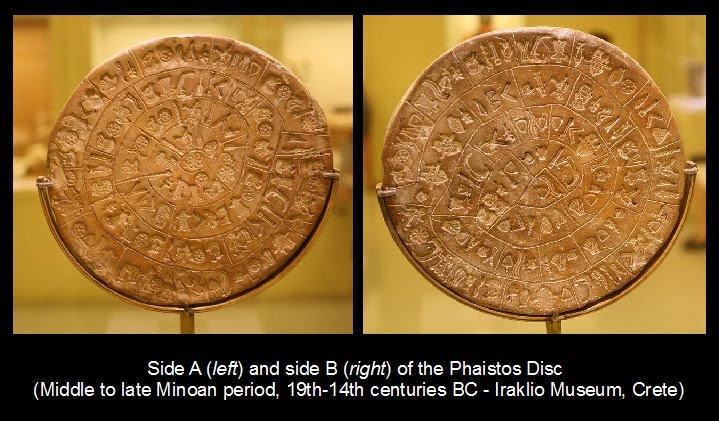
Ancient Scripts: The Phaistos Disk

The Phaistos Disk is an archaeological disc measuring around 16cm in diameter, discovered in the city of Phaistos in Crete. It is inscribed with symbols on both sides which date to around 1700BC. Studies show that it was a document brought from another place. This is because nothing similar has ever been found, however some symbols are similar to other Cretan inscriptions. It contains 241 tokens wit 45 unique designs. Many of which  represent every-day things.


These highly detailed signs were made by stamps and some have said that it is the earliest typewritten work. Enthusiasts have been trying hard to decipher the message within The Phaistos Disk but this is very difficult since there isn't enough significant text for analysis.


The History of Visual Communication, 2014. The Alphabet. [ONLINE] Available at: http://www.citrinitas.com/history_of_viscom/alphabet.html. [Accessed 29 March 2014].

Ancient Scripts, 2014. Phaistos Disc. [ONLINE] Available at: http://www.ancientscripts.com/phaistos.html. [Accessed 29 March 2014].


Friday, March 28, 2014

Task 1.1 - Illustrated Manuscripts (8/16)

Illustrated Manuscripts: Book of Kells

The Book of Kells is an Irish masterpiece and it contains the Four Gospels. It was written by Irish monks around 750 A.D. 
This manuscript was a codex which is made from sheets of vellum/calfskin and it is kept by the Roman Catholic Church. It features entire pages of beautiful decorations which are called carpet pages with only a line of text. These were used to separate the four gospels. 

The Book of Kells was written on calfskin, which is very time-consuming to prepare. It consists of 680 pages (340 foglios) and it is painted in at least ten colours. Some of the dyes were imported from other countries and therefore made them even more expensive.
The manuscript contains decorated initials and the lettering is in iron gall ink (made from iron sulfate).

 
Pages from the Book of Kells

Construction of Manuscript Books. 2014. Illuminated Manuscripts. [ONLINE] Available at: http://designhistory.org/BookHistory_pages/Manuscripts.html. [Accessed 28 March 2014].

Medieval History, 2014. The Book of Kells. [ONLINE] Available at: http://historymedren.about.com/od/bookofkell1/p/book_of_kells.htm. [Accessed 28 March 2014].

YouTube. (2011). Book of Kells ~ Part 1 Documentary. [Online Video]. 21 April 2011. Available from: https://www.youtube.com/watch?v=rRGQPJIO5CM. [Accessed: 28 March 2014].

Task 1.1 - Ancient writings: Cuneiform (9/16)

Ancient writings: Cuneiform

This is an early known writing system (c. 3000 B.C.E.) which consists of ‘wedge’ marks. It was written on clay tablets which were a writing medium during Bronze Age. Cuneiform was invented in southern Mesopotamia and includes syllabic scripts and logosyllabic scripts. Any script which contains wedges can be called cuneiform since it derived from the Latin word cuneus (wedge).


The earliest writing was based on pictograms. Therefore cuneiform characters were evolved from pictograms which had been rotated and changed into symbols and organized in horizontal rows.

Pictograms to Cuneiforms

This writing was written from left to right, and it is believed that it helped right-handed people to avoid smearing their work while writing.
Cuneiform writing was used for thousands of years which recorded daily events such as astronomy, trade and literature. 

The following are examples of : Early Cuneiform, Evolved Cuneiform and Akkadian Cuneiform.


Personal thought: In my opinion the Early and Evolved Cuneiform resemble the Chinese characters. On the other hand there is a contrast between these two ; Chinese is written vertically and it is not an alphabetic script.


Erin Singleton's Portfolio, 2014.Cuneiform and the Sumerians [ONLINE] Available at: http://erinsingleton.wordpress.com/2011/02/16/cuneiform-and-the-sumerians-3500-b-c/. [Accessed 28 March 2014].

Graphic Design History, 2014. Development of Writing : Using Clay and Stone. [ONLINE] Available at: http://www.designhistory.org/Handwriting_pages/EarlyWriting.html. [Accessed 28 March 2014].

Writing, 2014. Writing. [ONLINE] Available at: http://www.mesopotamia.co.uk/writing/home_set.html. [Accessed 28 March 2014].


Thursday, March 6, 2014

Task 1.6 - References for the Illustrated academic essay

For my Task 2 essay I will be using ArchBook which is an open-access collection of illustrated essays about features in the history of the book. This open source is quite reliable since it contains encyclopedic resources such as the Cambridge History of the Book in Britain and is currently supported by the University of Toronto's iSchool.  In the essay I will be comparing and linking different types of interactive works, both historical and contemporary. In my opinion,  ArchBook is quite useful since it connects works from both periods regarding interactivity in books. Another feature which I found extremely useful is that each topic has its own definition and historical overview (like Wikipedia but with academic standards).
For the historical part I will be discussing Volvelles and Flaps(pop ups). These were both early interactive works.


What are Volvelles? What was their use?

Volvelles consist of one or more layers of circular discs which were fixed firmly to a leaf; each disc was rotated separately from the others. This medieval instrument performed calculations for a variety of purposes but mostly to calculate the motion of the Moon in relation to that of the sun. "Volvelles in particular have been called 'astronomical computers' due to their ability to perform basic computational exercises such as calculating astronomical phenomena..." (Gravelle M., Leroux C., Mustapha A., 2012). The first known Volvelle was created by Matthew Paris (Benedictine Monk) in 1250. He got inspired from the circular charts that appeared in the abbey's books.
Volvelles were a popular addition in astronomy books such as the one found in Johannes Sacrobosco's Sphaera, which is a 13th century astronomy text. (fig. 1)

block image
Figure 1 - Sphaera from Ioannis de Sacrobosco, Sphaera (Paris: Apud Gulielmum Cauellat,1552).
 Image courtesy of Thomas Fisher Rare Book Library.

Like volvelles, flaps or pop-ups also represented an early interactive interface. Flaps were also found in books during the 16th and 17th centuries, especially in anatomy books where several pieces of paper(flaps) were "pasted and arranged to depict various layers of viscera. Readers of such books lift or separate these flaps to reveal the interior anatomy of the human body. "(Lindsay McNiff and Michelle Kelly Schultz, 2012). Since flaps were used to explain subjects that required three-dimensional imagery, one may find various pop-ups in geometry books such as  Euclid’s The Elements of Geometrie. The flaps were cut to lie flat, which allowed the book to close naturally. (fig. 2)

block image
Figure 2 - Geometric Flaps used to represent 3-dimensional shapes, Euclid's The Elements of Geometrie.


Bibliography:

ArchBook, 2014. Architectures of the Book [ONLINE] Available at: http://drc.usask.ca/projects/archbook/index.php. [Accessed 06 March 2014].

ArchBook, 2014. Architectures of the Book - Flaps [ONLINE] Available at: http://drc.usask.ca/projects/archbook/flaps.php. [Accessed 06 March 2014].

Gravelle M., Leroux C., Mustapha A., 2012. Architectures of the Book - Volvelles. [ONLINE] Available at: http://drc.usask.ca/projects/archbook/volvelles.php. [Accessed 06 March 2014].


V&A Collection (Victoria and Albert Museum)

Another source which I will be using for my essay is an article from the V&A Collection. This source is quite reliable since it offers links to online collections in the Victoria and Albert Museum. This Museum is situated in London and is the world's greatest museum of art and design.
This website offers a preview of current exhibitions and also content related to past exhibitions. The V&A Collection website is divided into tabs according to various art movements. Therefore one can search the collection according to the desired period. It also offers a number of courses where one can take part in yearly courses and gain knowledge regarding art periods.


This museum/website has a collection of over 4.5 million objects, from which I found a book consisting of 20 sheets of paper joined together. This was made to form a panorama of the Queen's Coronation Procession. This took place in June, 1838 and the artist of this panorama was Joseph Robins.


This lithography was painted by hand on cloth boards. It also has "the title in gilt on the front cover, and a gilt crown on the back cover; Inside the covers, and on a sheet of paper, are the publisher's title and advertisements; Published by Joseph Robins, Bride Court, Fleet Street and C. Tilt, Fleet Street, London; 1838." (V&A Images , n.d)

Since the Queen was crowned when she was only 19 years old, the monarch required a lighter crown therefore "on the outer cloth boards there is a gilt embossed image of 'The Queen's New Crown'." (V&A Images , n.d)


Bibliography:

V&A Search the Collections, 2014. Print | Robins, Joseph (and C. Tilt). [ONLINE] Available at: http://collections.vam.ac.uk/item/O78226/print-robins-joseph-and/.  [Accessed 01 April 2014].